Crochet hooks may seem simple, but small differences in the handle, hook head, throat, material and size can make a big difference in how they feel and perform.
This page is designed to help you understand those differences and find a hook that suits your hand, your yarn and your project.
Three simple ways to start, depending on the type of crochet you want to do.

The most straightforward option: choose the hook size recommended by the pattern or yarn and start crocheting.
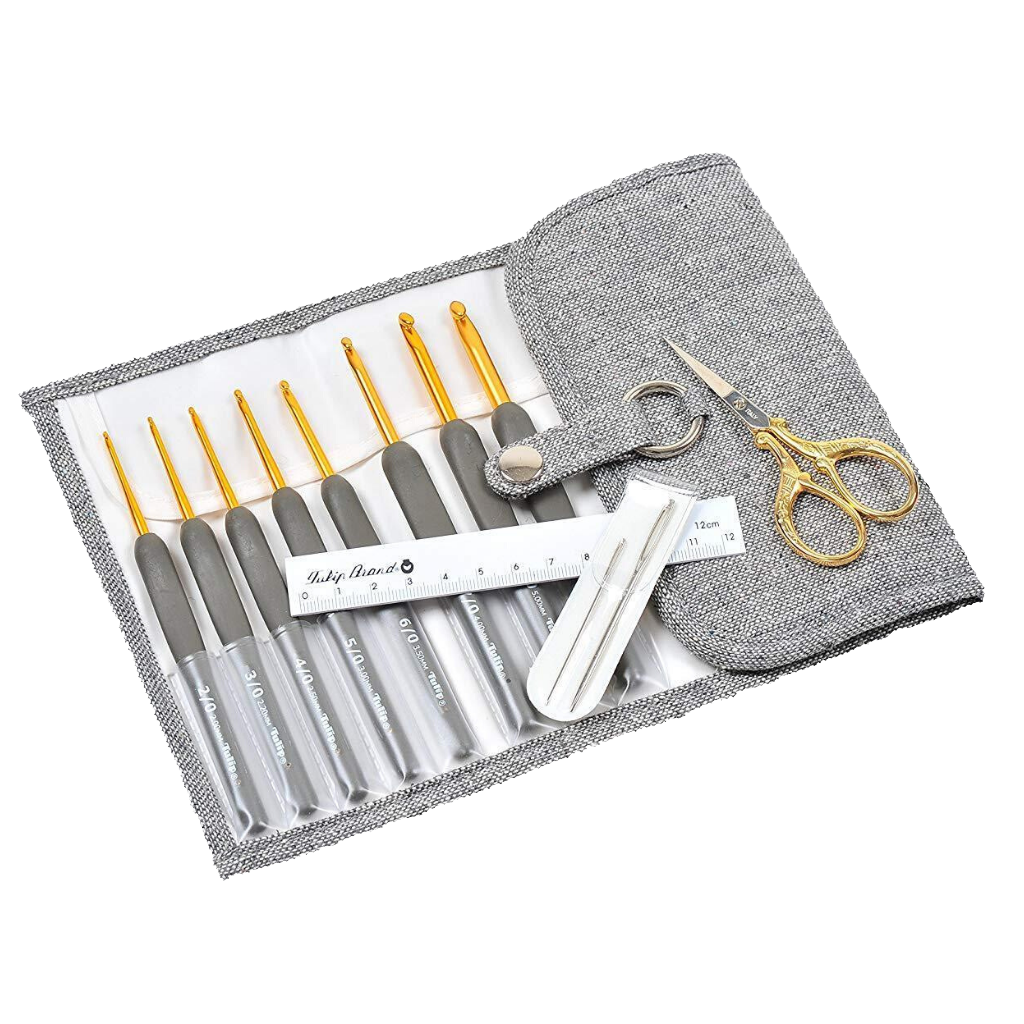
A practical way to keep several hook sizes from the same range together and organized.

For techniques that keep multiple stitches on the hook and require specialized tools.
In crochet, small differences in the handle, hook head, throat, length and surface can significantly change the experience. That is why we carry several brands and ranges: not because they all do the same thing, but so you can find the tool that best suits your hand and your project.
The pattern or yarn label is your first reference. Your swatch will confirm whether you need to go up or down a hook size.
It may be straight, compact, ergonomic, cushioned or part of an interchangeable tool.
The shape of the tip and the depth or angle of the throat affect how the hook enters the stitch, catches the yarn and releases it.
Start by choosing the type of tool you need.
For adding specific sizes or trying different brands, handles and hook geometries.
View individual hooksFor keeping several sizes together within the same collection.
View crochet hook setsFor a specific technique that requires different tools and lengths.
View Tunisian crochetEach manufacturer approaches the relationship between hook head, throat, handle, material and hand feel differently. If you already know a range that feels comfortable to you, that is a good place to start.
At Budetex, we are OFFICIAL DISTRIBUTORS in Argentina for the brands we carry. We provide local support and continuity across the collections we offer.
There is no single ideal handle or hook shape for every hand.
The handle changes how you hold the tool and distribute pressure. An ergonomic handle may feel more comfortable for many people, but preference remains personal. If you like to feel the tool very close to the stitch, a compact handle or a straight hook such as KnitPro Zing may feel natural. If you prefer more surface area to hold, consider ranges such as Tulip ETIMO, Clover Soft Touch, KnitPro Waves 2.0 o Prym Ergonomics.
The tip is the part that first enters the stitch. The throat or groove is the area where the hook catches the yarn before pulling it through the stitch. Small changes in the curve of the hook head, the depth of the groove or the throat angle can affect how much control you feel and how easily the hook moves in and out of the stitch.
There is no universal classification used in exactly the same way by every manufacturer. For that reason, we prefer to group hooks by geometric behavior rather than claiming that one shape is better than another.
This geometry often feels smooth and gentle on the yarn. It can be especially pleasant with soft fibers, lightly twisted yarns or when you prefer short, continuous movements.
Clover Soft Touch · rounded tip and shallow groove.
KnitPro Gold · a gentler hook-head curve within the KnitPro range.
It can make it easier to enter tight stitches and provide a more pronounced yarn catch. Some crocheters prefer this geometry for amigurumi, dense stitches or materials that benefit from greater definition.
Tulip ETIMO GrandHook · compact, pointed head with a deep throat for bulky yarns.
KnitPro Ginger · more pointed head and a more pronounced throat angle.
Many premium hooks do not fit neatly into either extreme. Their geometry is designed as a whole to balance stitch entry, yarn capture and release.
Tulip ETIMO Red · ETIMO Gold · Clover Amour · KnitPro Zing · Waves 2.0 · Prym Ergonomics.
You find it difficult to enter very tight stitches → try a slightly more defined tip.
The hook tends to split or snag the yarn → try a more rounded hook head or a gentler throat.
You crochet for many hours → consider the hook geometry together with the handle; the two work as a system.
Control, precision and a hook head that can enter tight stitches comfortably.
Comfort over long sessions, smooth glide and a geometry that does not require unnecessary movement.
Larger hook sizes, enough throat depth to accommodate bulky yarn and handles proportioned to the material.
Small hooks, a well-finished surface and precise geometry. Steel ranges are especially well suited to these sizes.
Your first reference should be the hook size recommended by the pattern or yarn. Your swatch confirms the choice and may show that you need to go up or down a size.
Not for everyone. It can be very comfortable, but grip style, hand size and movement vary from person to person.
Yes. A more defined tip can make it easier to enter tight stitches, while a more rounded head may feel gentler on certain yarns. Throat depth and angle also affect how the yarn is caught and released.
There is no universal rule, but when working very tight stitches many crocheters prefer a well-defined tip because it can make stitch entry easier. The final choice also depends on the yarn and your tension.
An individual hook gives you one specific size and lets you try a range before investing further. A set includes several sizes and can be more convenient if you crochet regularly and already know what handle and hook shape you prefer.
Yes, especially with premium ranges. If you are deciding between two families, choose a size you use often and try a single hook first. Differences in handles and geometry are often much more noticeable in your hand than they are on a specification sheet.
It is a technique that keeps multiple stitches on the hook during part of the process and requires specific tools, usually longer hooks or hooks connected to a cable.
Brands and ranges help organize the options. The final choice depends on how you hold the tool, the yarn, the project and which geometry feels most natural after many stitches.


